
What Is Montessori?
What Montessori actually means.
It's a word a lot of people have heard and few can define. Here's the plain version.

the philosophyRespect, in three directions.
Ask our director what Montessori is and she'll answer in one word: respect.
01 / Respect for yourself
A child is capable of far more than we usually let them do. Pouring their own water. Choosing their own work. Sticking with something difficult without an adult stepping in to rescue them. Children who are trusted with real things become children who trust themselves.
02 / Respect for others
The school holds a three-year age range on purpose. Older children help the younger ones, and the younger ones learn by watching. Nobody is competing. Everyone is somebody's example.
03 / Respect for the environment
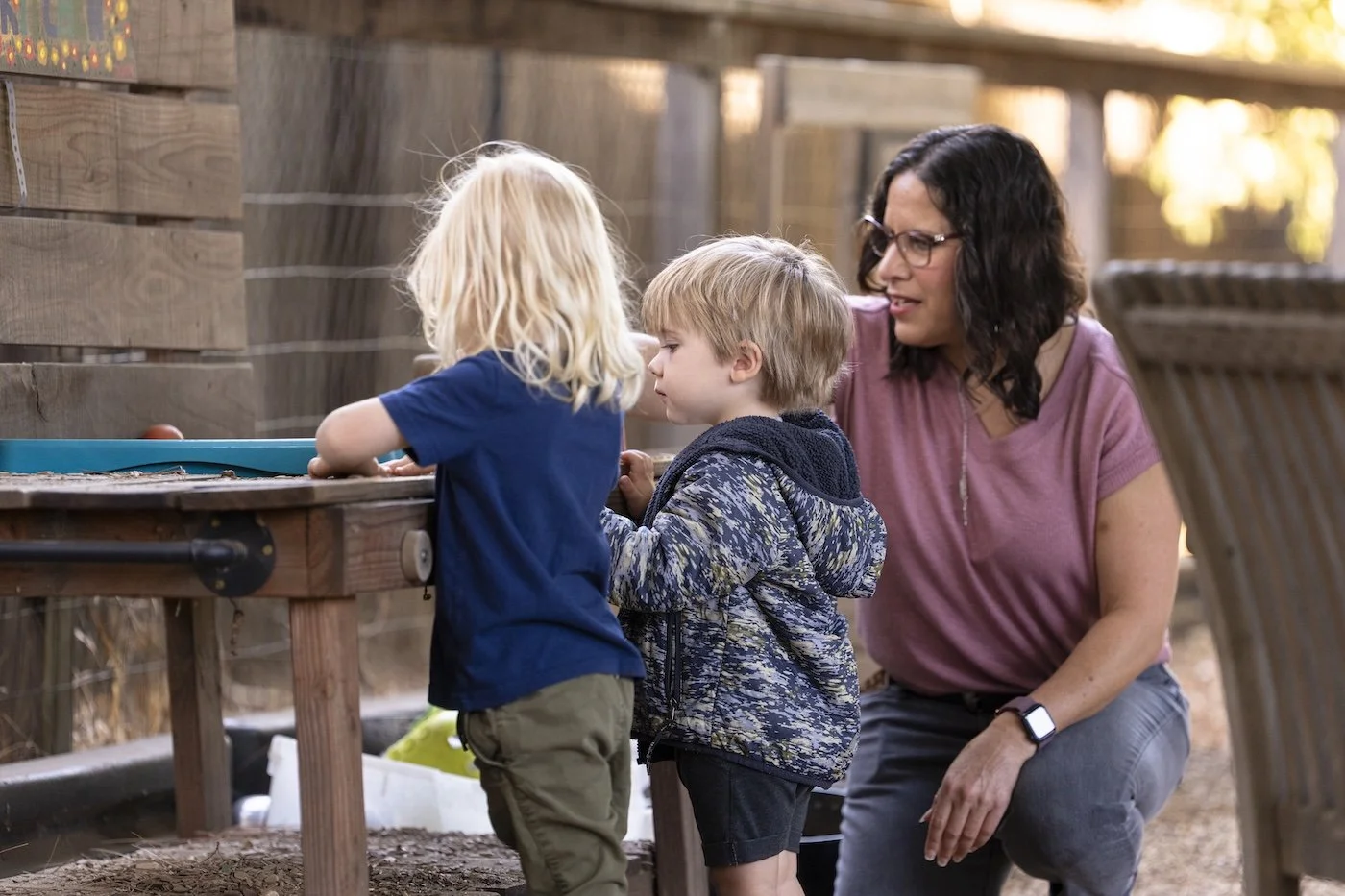
The materials get returned to the shelf. The plants get watered. And because the children spend their mornings out among the trees, the natural world isn't an abstraction to them — it's the place they've spent every day since they were 2½.
the classroomQuieter than you'd expect.
The first thing most parents notice on a tour is the noise level. A dozen or so children in a room, no one at the front of it, and it's calm.
-
![A wooden box containing colorful small beads on a white shelf.]()
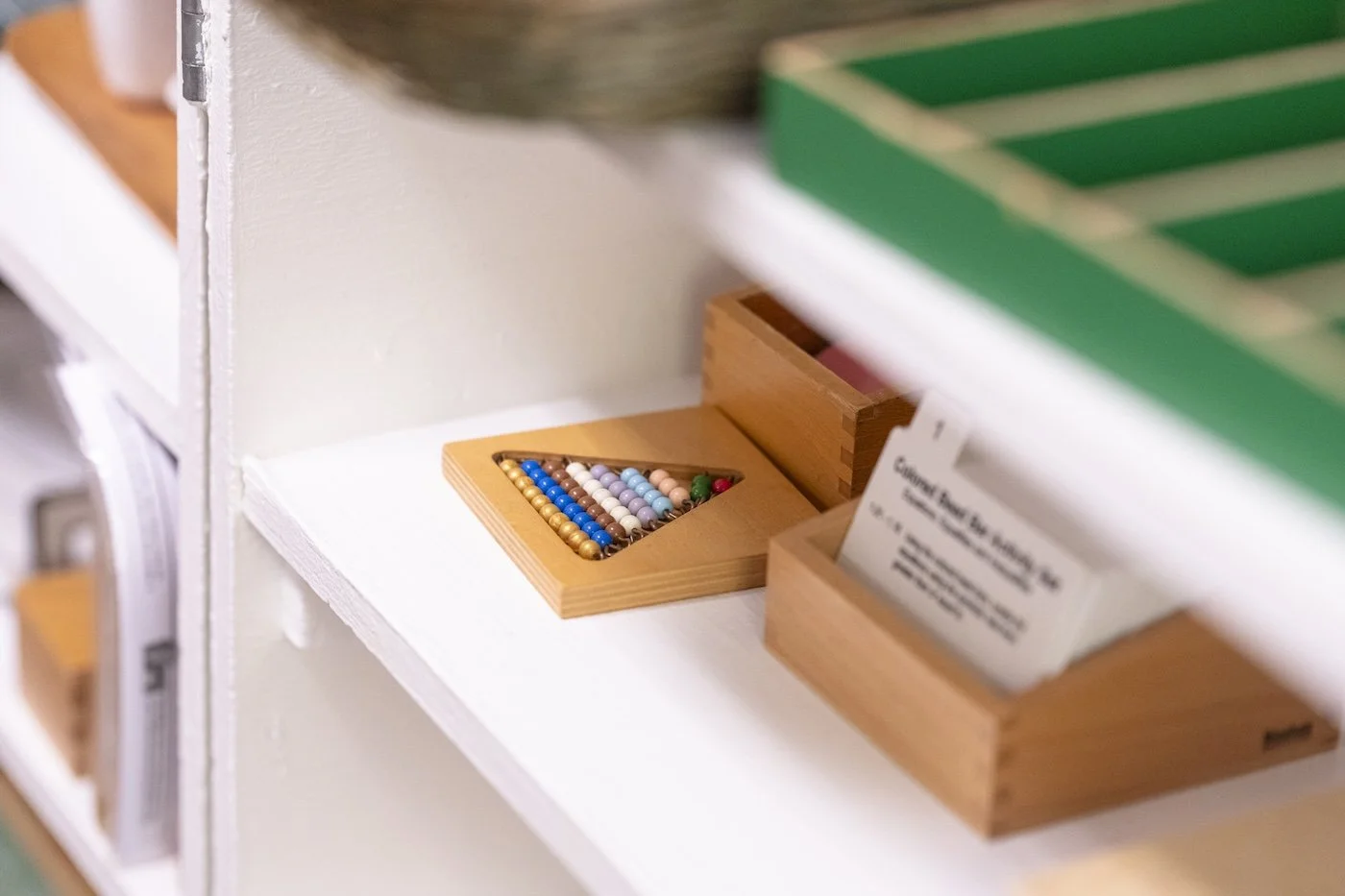
The room is thoughtfully set up in advance.
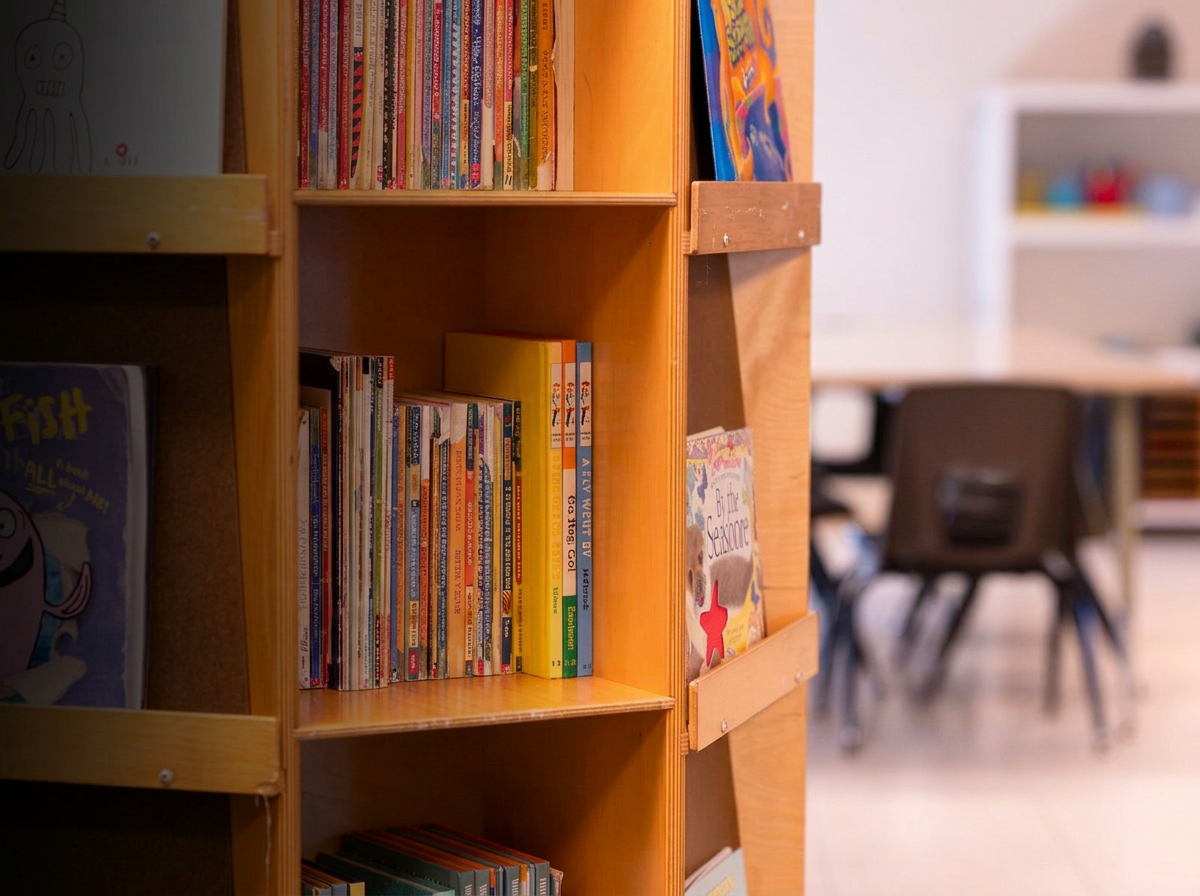
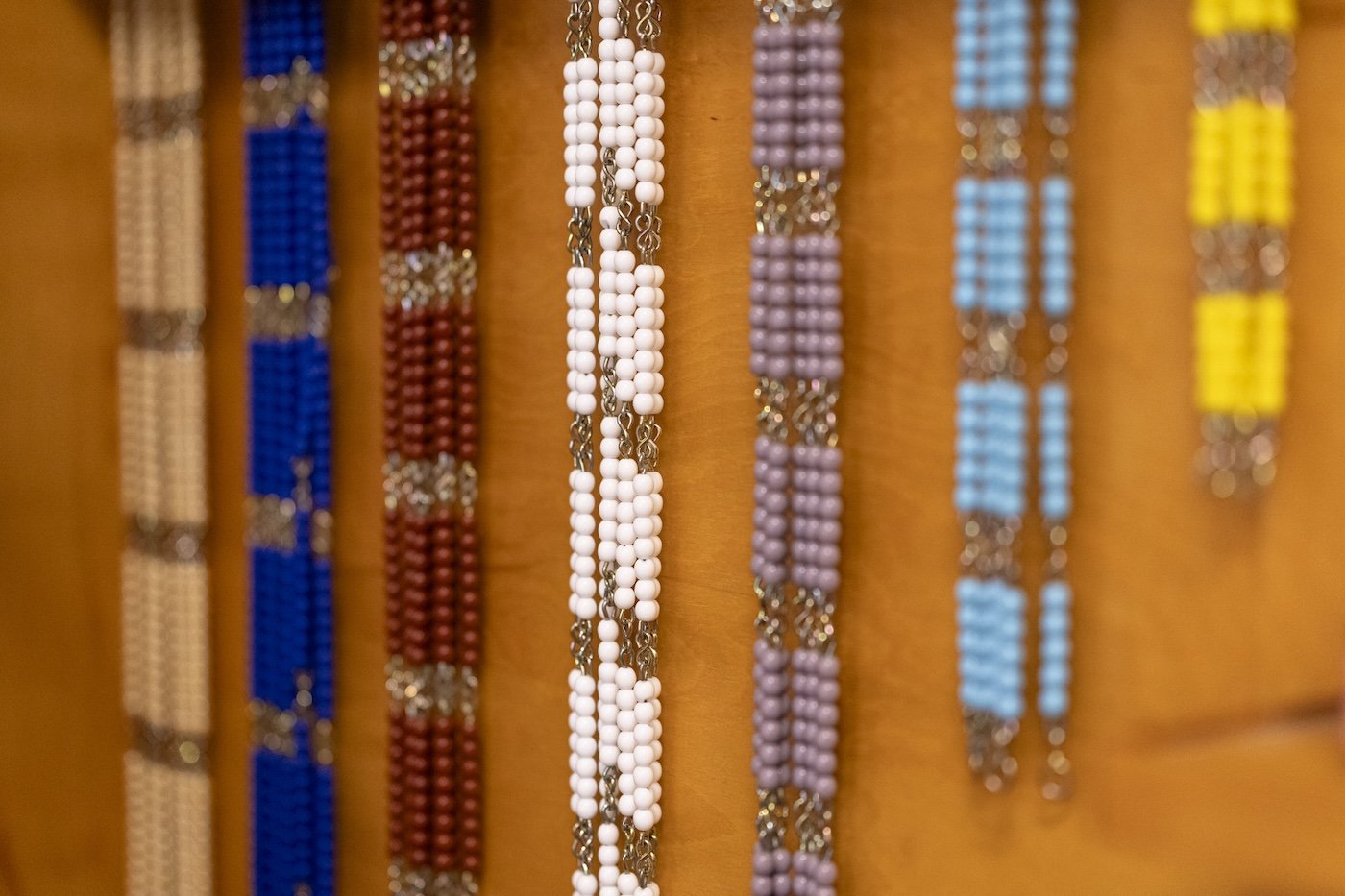
Every material sits on an open shelf at child height, in a fixed place, arranged roughly from simplest to hardest. A child can see everything available to them and reach it without asking. Montessori called this the prepared environment, and it's doing as much work as any adult in the room.
-
![Teacher kneeling on the floor helping children with a wooden educational activity, classroom scene with children at a table and playing on the carpet.]()
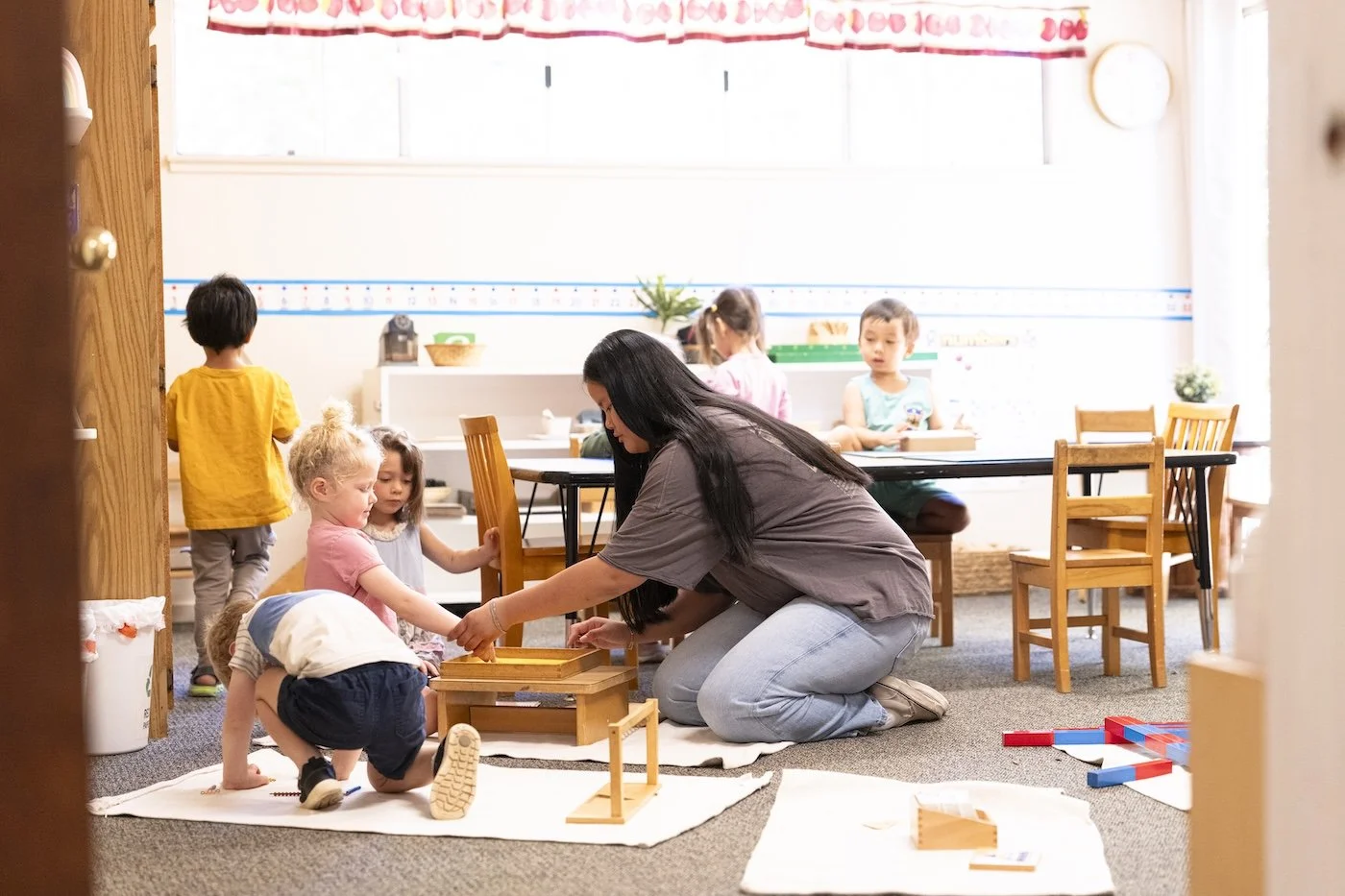
The whole school is the environment.
Many Montessori schools prepare one classroom. Here, each room is organized around a different area of the work — practical life in one, math in another, language arts and science in a third, sensorial and geography in the fourth. For part of the day, children move between them and choose where to go based on what materials they have had a lesson on. The rest of the time they work with their group in one room, with that room's teacher, rotating through the week so every child spends time in every area.
-
![A child's hand holds a yellow card labeled 'Winter' on a table with educational materials, including other cards, a rolled-up paper, and a colorful tree-shaped object, likely for a learning activity about seasons.]()
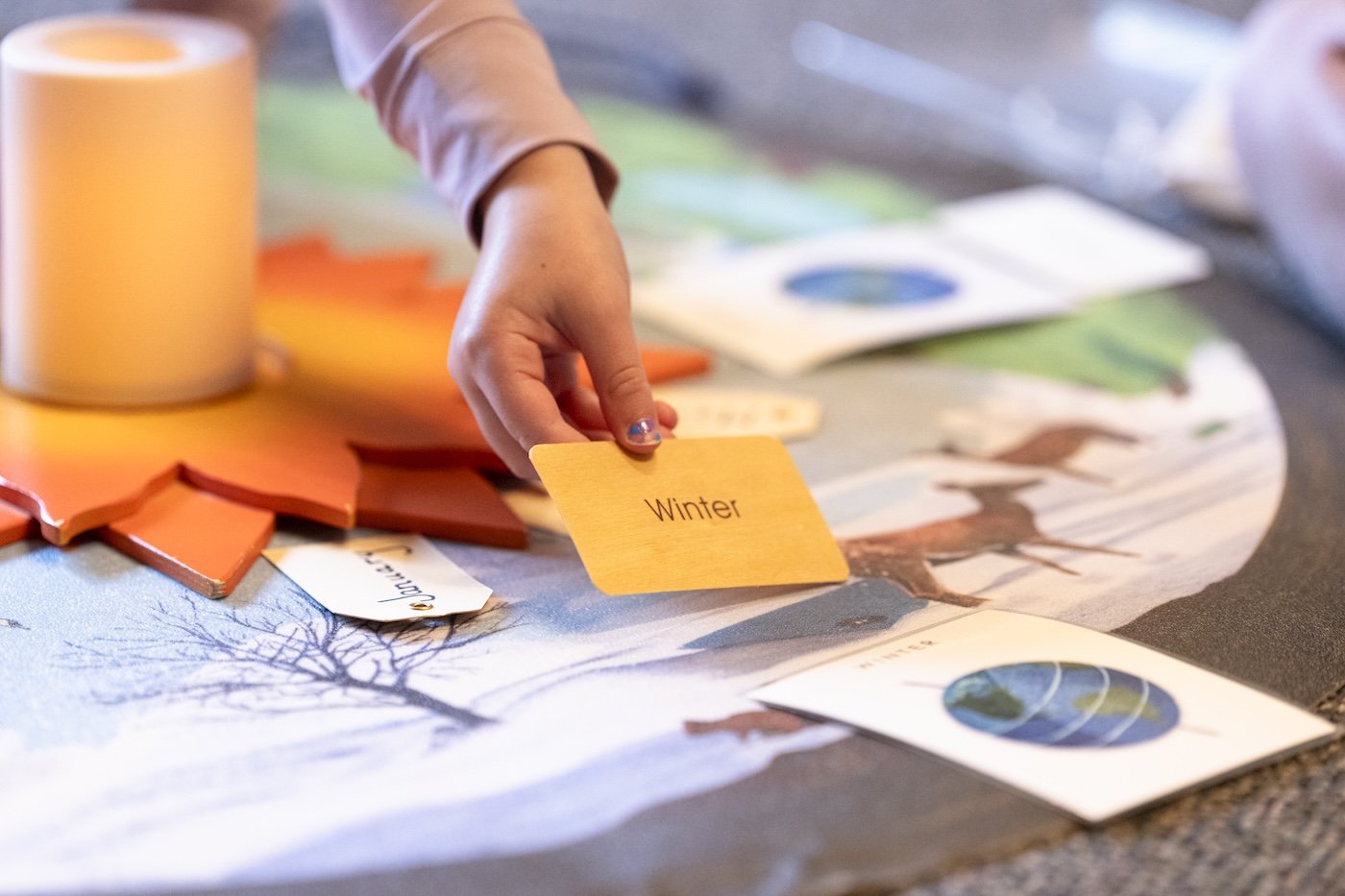
They're called jobs.
That's the school's word for the work, and the children use it too. It's a small thing that says a lot about how the work is regarded here. A job has a beginning and an end, it belongs to the child who chose it, and it gets put away when it's done. Ask a four-year-old at pickup how their day was and you may well hear which jobs they did.
-
![A person's hand reaching for beaded earrings hanging from a numbered wooden rack, with earrings in various colors.]()
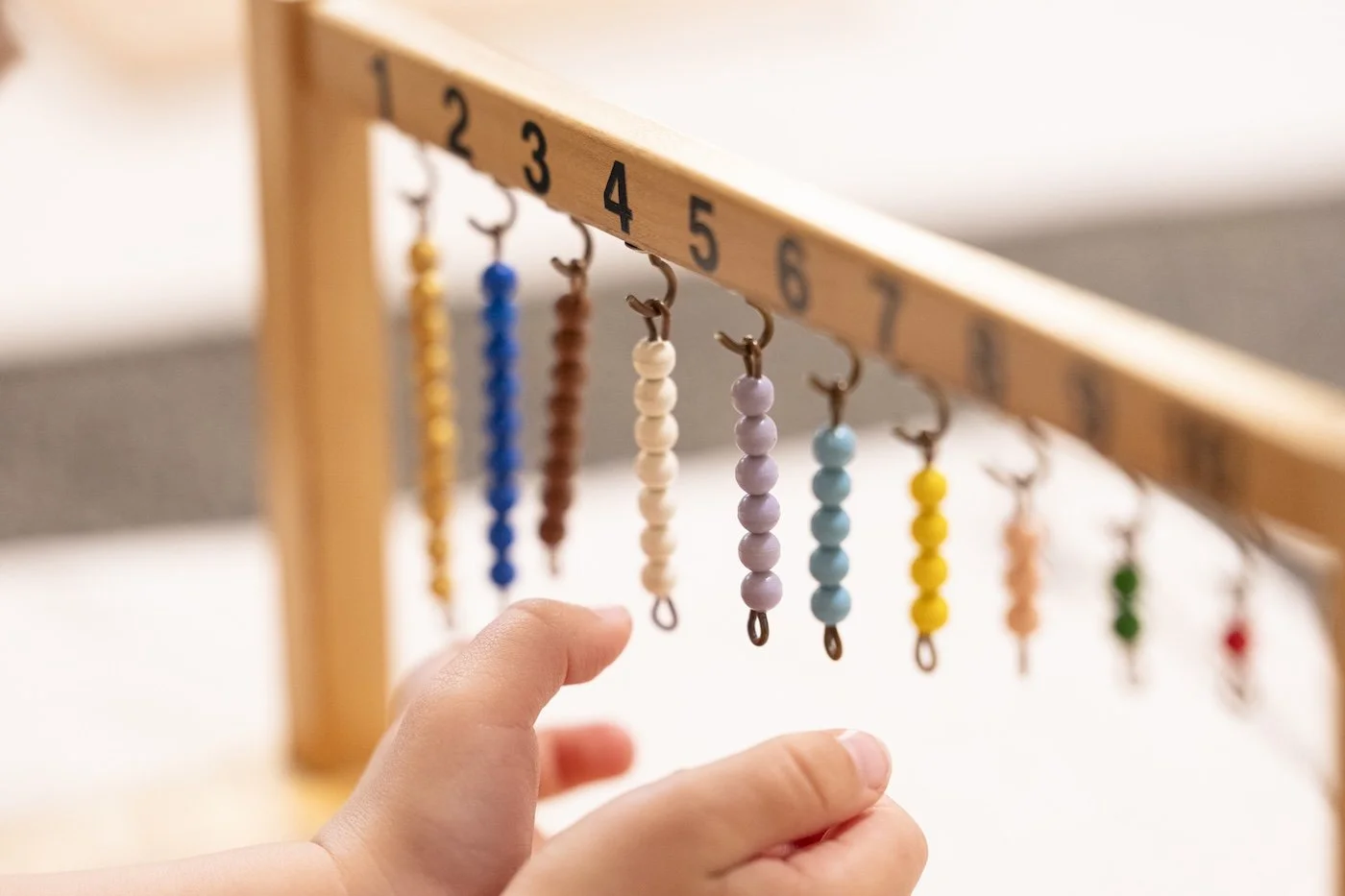
The materials teach.
They're beautiful, and most of them are designed so that a child can tell for themselves when something isn't right — the last block doesn't fit or the shapes don't match. That means a child can correct their own work without waiting for someone to check it.
-
![A young girl sitting at a table, leaning forward, drawing or coloring with colored pencils from a metal container labeled "Class of 2016."]()
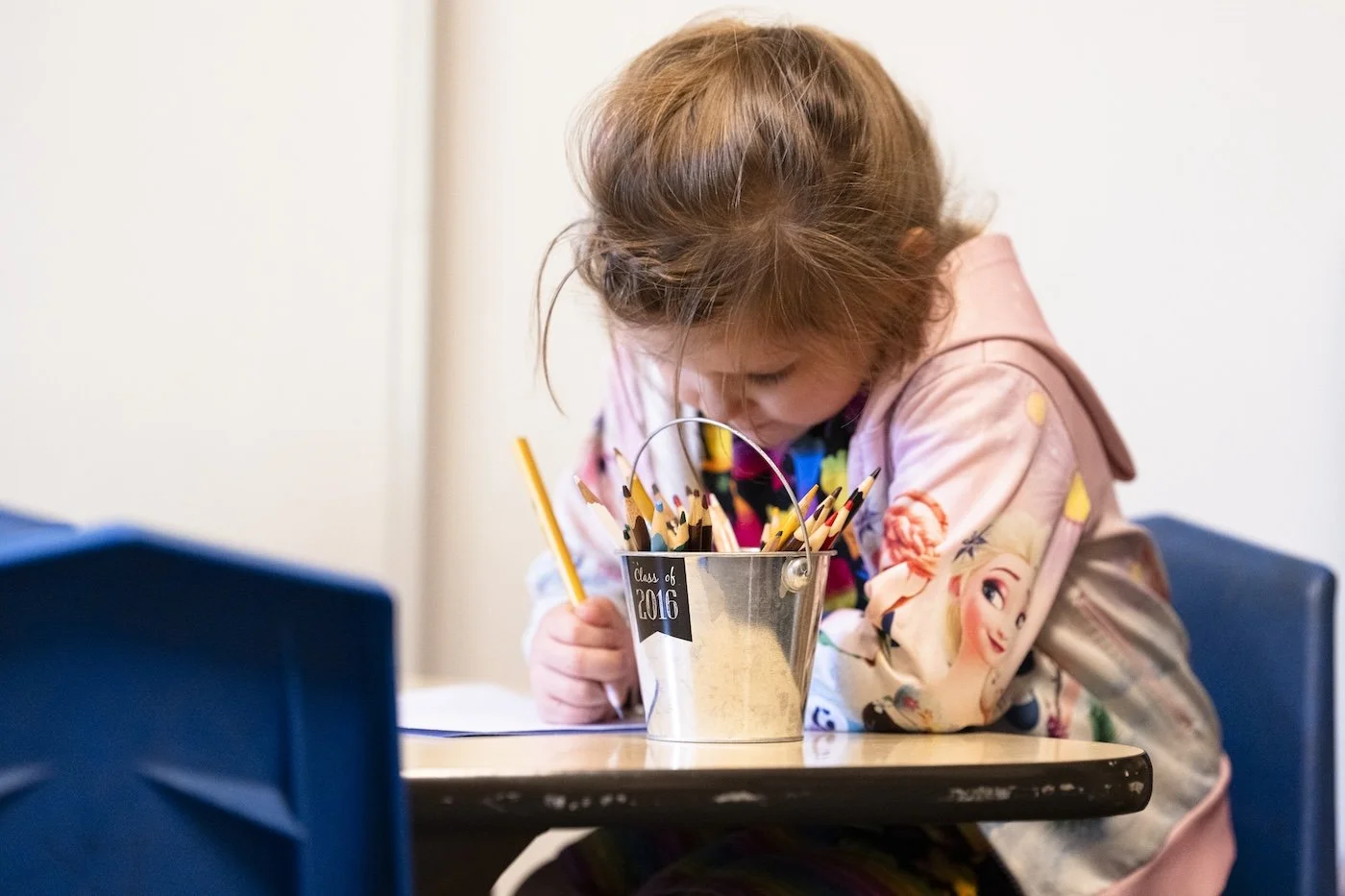
The work period is long.
Children get an uninterrupted stretch to choose their jobs and stay with them. That length is the point. Deep concentration takes a while to arrive, and we give the children time for that.
-
![A teacher and a young girl sitting on the carpet in a classroom, engaging in a learning activity centered around a colorful, circular game or puzzle on the floor, with wooden shelves and educational materials in the background.]()
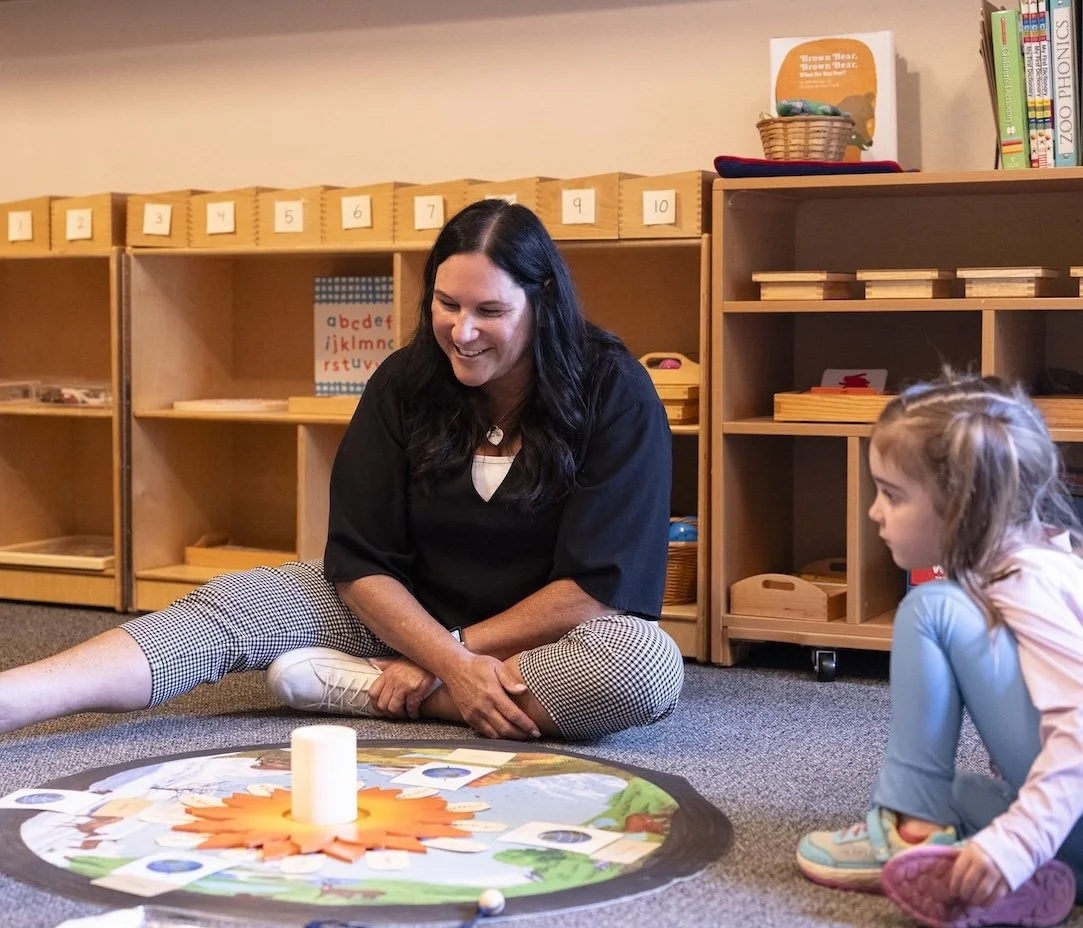
The teachers move around the room.
They give short individual lessons, watch closely, and otherwise stay out of the way. The Montessori term is guide, and it's accurate — the teacher's job is noticing what a particular child is ready for and introducing it to them at the right moment.
the groups
Yellow, blue, red.
Children at Redbud belong to one of three groups, and they move up as they grow. The groups are how children are organized for Montessori presentations and thematic lessons. Across a week, every group works with every teacher and every area of the curriculum.
Montessori's reasoning for the mixed ages was straightforward. Older children are often the most useful role models a young child has — better, sometimes, than an adult, because the distance is smaller. A four-year-old watching a six-year-old carry a tray of water across a room is watching something genuinely achievable.
That only works if children stay long enough to become the older ones. It's why the school was built around a three-year cycle from the start.
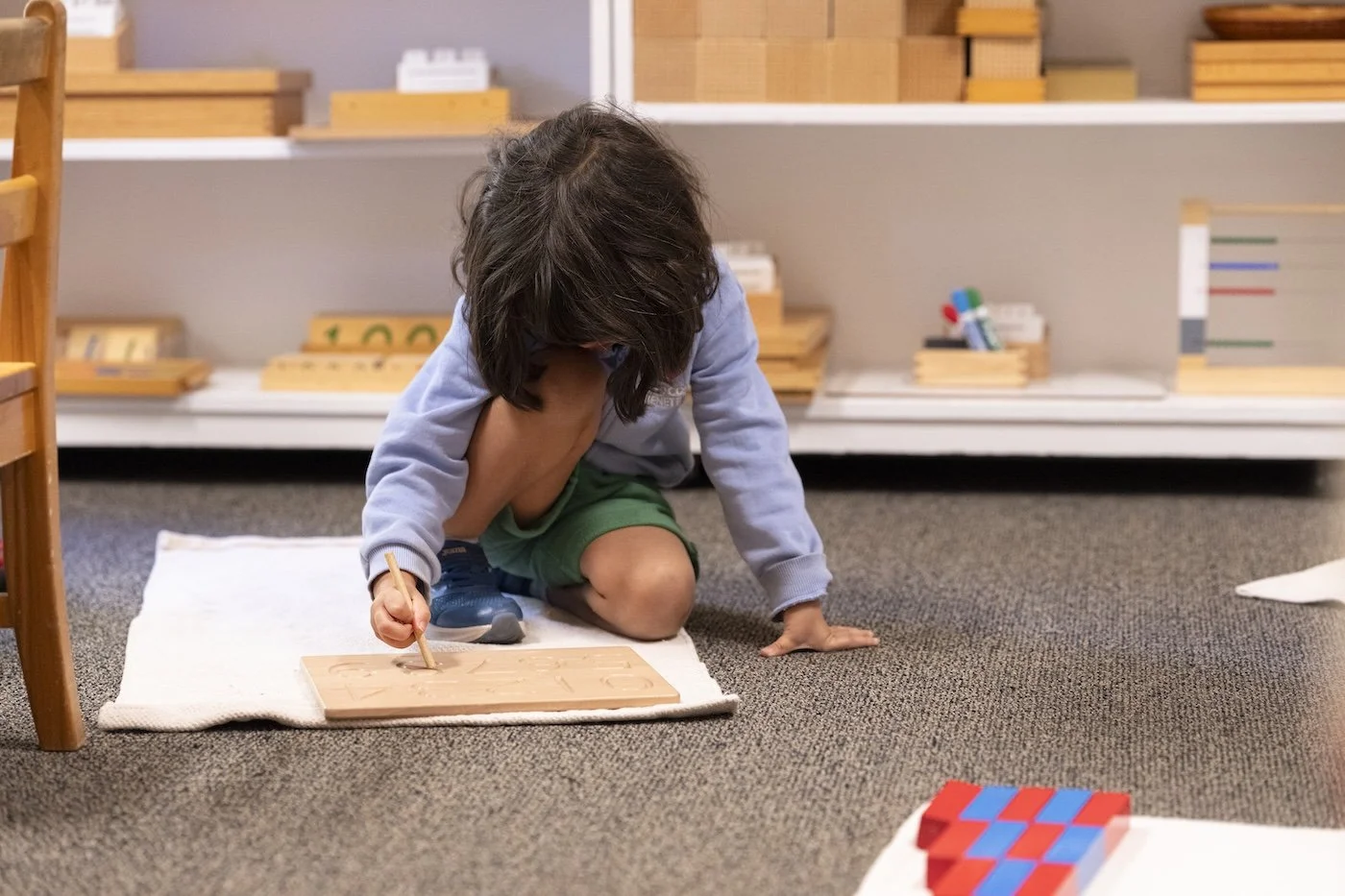
Yellow · ages 2½–4
The youngest. Learning how the school works, how to care for themselves, and how to be part of a group.
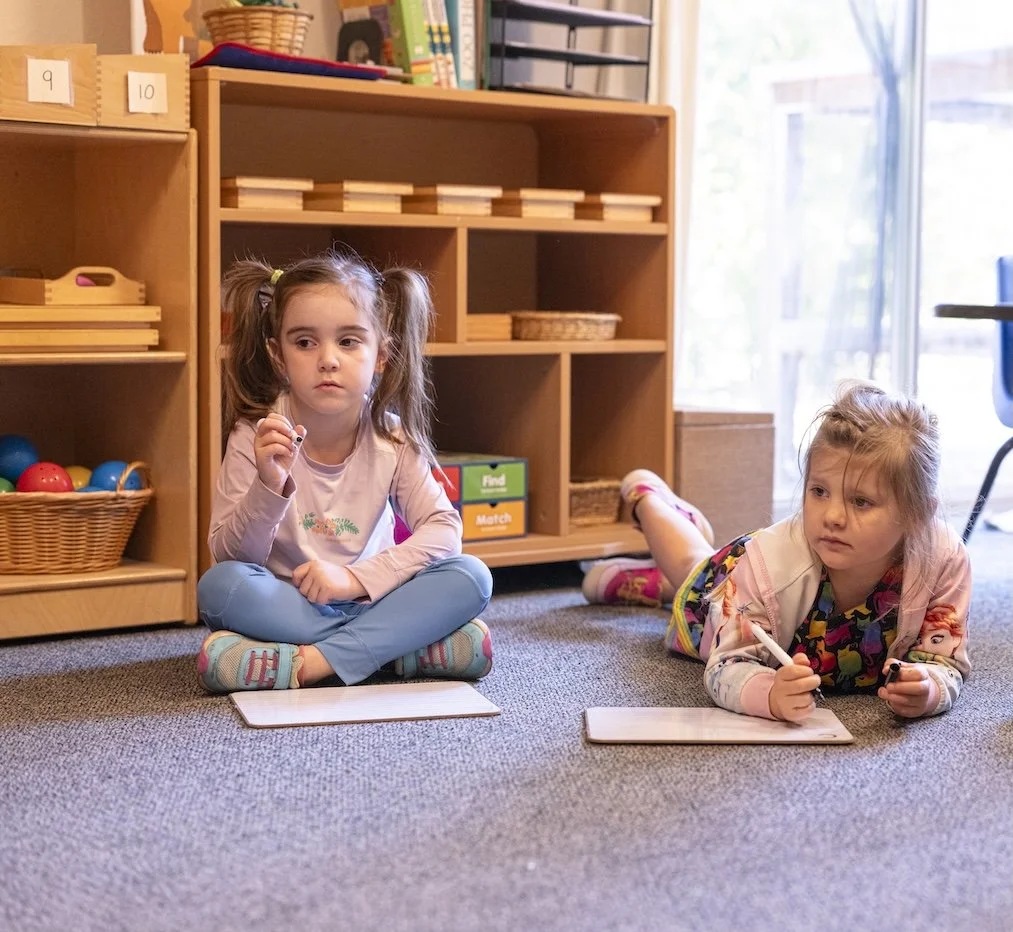
Blue · ages 4–5
The middle. Confident now, deep into the materials, and starting to be someone a younger child looks up to. The blue group year is also a year of socialization and practicing their conflict resolution skills.
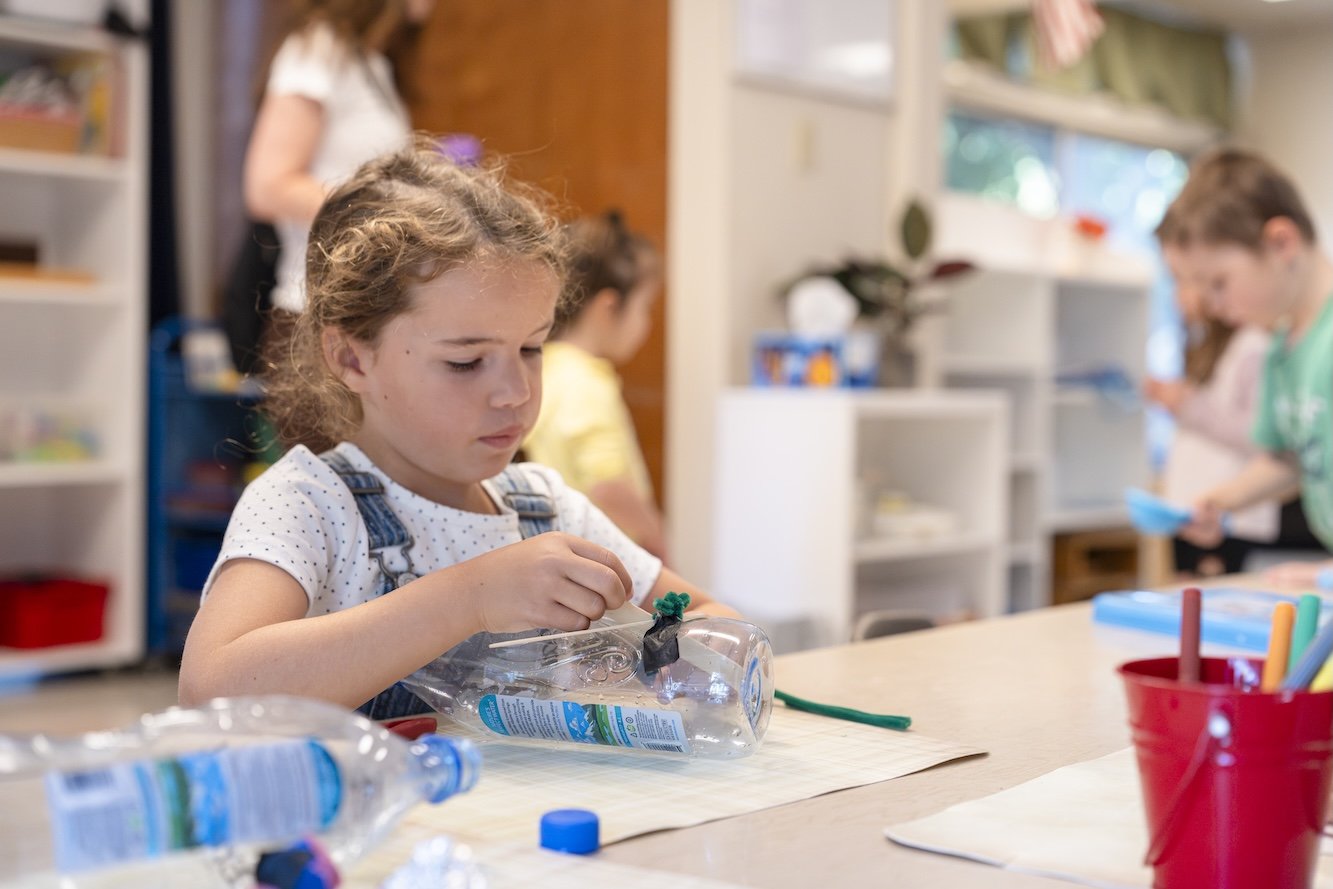
Red · ages 5–6
The kindergarten year. The oldest children in the room, leading it and teaching in it.
About the last two years →
"There is a great sense of community within the Montessori classroom, where children of differing ages work together in an atmosphere of cooperation rather than competitiveness. There is respect for the environment and for the individuals within it, which comes through experience of freedom within the community."
— Maria Montessori
common questionsThe two opposite worries.
Parents often arrive with one of two impressions, and they contradict each other.
“Isn't it a free-for-all?”
No. Children choose their work, but the choices are prepared, the rooms have clear expectations, and behavior that would disrupt or hurt someone else isn't permitted. Montessori was direct about this — give children the freedom to act, explore and make choices, but within limits that ensure safety, respect and the collective good. We call this “freedom within the structure.
“Isn't it rigid?”
Also no. The materials have a right way to be used, but children work at their own pace, on what interests them, for as long as they like. Nobody moves through a workbook in lockstep. Once a child has mastered a job a teacher may ask them, “Show me another way.”
What Maria Montessori actually built sits between those two things — real freedom, inside a structure a child can rely on.
the real goalWhat we're actually after.
Montessori children often turn out academically ahead, and Redbud's are no exception — many are reading before they leave. But it's worth being honest that this isn't the goal. It's what happens when a child has years of sequential lessons with beautiful Montessori materials offered at their own pace.
What we're actually after is harder to test for. A child who can choose their own work and finish it. Who can be told no without falling apart. Who helps a younger child because they've been helped. Who's curious about things because nobody has ever made curiosity a chore.
Montessori put it plainly enough: “You can't manufacture a genius — you can only give a child the chance to become independent, secure, and balanced.”
see for yourselfAll of this is easier to see than to read about.
A page can explain a work period. Watching a four-year-old deeply concentrating on something they chose is a different experience entirely.